By increasing accuracy, boosting patient safety, and assisting surgeons in making well-informed decisions, artificial intelligence (AI) is quickly revolutionizing contemporary surgery. AI-powered devices are becoming indispensable instruments in operating rooms across the globe as healthcare institutions continue to adopt digital innovation. AI is assisting surgeons in achieving better results while lowering complications and recovery times using robotic-assisted operations, medical imaging, and predictive analytics.
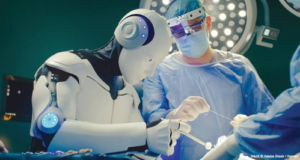
The goal of incorporating AI into surgical practice is to improve rather than replace surgeons. AI helps medical personnel diagnose illnesses, schedule procedures, and monitor patients before to, during, and following surgery by evaluating vast volumes of medical data in a matter of seconds. AI is anticipated to have an even bigger impact on surgical treatment in the future as technology develops.
The Application of Artificial Intelligence in Contemporary Surgery
AI is incorporated into many facets of surgery using improved robotics, computer vision, and machine learning. These tools help surgeons with difficult surgeries, handle patient data, and interpret medical images.
Among the most significant applications are:
》Automation of workflow and medical documentation.
》real-time decision assistance during operations.
》predictive analysis of surgical risks.
》post-operative patient monitoring.
》surgical planning utilizing medical imaging.
》robotically assisted surgery.
These developments increase surgical accuracy while assisting medical professionals in making quicker and better judgments.
Robotic Surgery Driven by AI
Robotic-assisted surgical devices are among the most important advancements in contemporary surgery. Surgeons may execute minimally invasive treatments with more control and precision because to these platforms.
AI-assisted software can enhance visualization, lessen hand tremors, and offer helpful direction throughout the procedure, even if the surgeon is still ultimately in charge of every action.
Robotic-assisted surgery has the following advantages:
● Reduced hospital stays
● Reduced discomfort following surgery
● Decreased blood loss
● Enhanced accuracy during surgery
● Quicker recuperation of patients
● Reduced chance of infection
Due to these benefits, robotic surgery is becoming more and more popular in fields including general surgery, urology, gynecology, cardiology, and orthopedics.
AI Enhances Surgical Planning
AI helps surgeons create individualized treatment plans by analyzing patient information, lab findings, CT scans, MRIs, and X-rays prior to surgery.
Surgeons can use machine learning algorithms to find patterns that might not be immediately apparent to the human eye, enabling them to:
● Calculate how long the operation will take.
● Enhance general surgical readiness
● Forecast potential issues
● Choose the best surgical tools.
Improved patient outcomes and fewer complications are frequently the results of better preparation.
Medical Imaging with Artificial Intelligence
One of the best fields where AI shows great promise is medical imaging.
AI algorithms can swiftly examine imaging studies to find anomalies like:
● The development of cancer
● Breakage
● Damage to organs
● Vascular disorders
● Tumors
This enables surgeons to diagnose patients more accurately and start treatment earlier.
Additionally, computer vision technology aids in the development of intricate three-dimensional anatomical models that enhance surgical navigation during challenging procedures.
Decision Support in Real Time During Surgery
During an operation, modern AI technologies give surgeons real-time information.
These clever systems are capable of:
● Inform surgeons about possible issues.
● Suggest surgical measures
● Determine the anatomical structures
● Keep an eye on your vital indicators
AI functions as an intelligent assistant that improves clinical decision-making rather than taking the place of surgical competence.
Forecasting the Risks of Surgery
Another significant use of AI in surgery is predictive analytics.
AI models assess a patient’s risk of experiencing issues like these by looking through millions of past medical records:
● Infections at the surgical site
● Readmission following surgery
● Blood clots
● Failure of organs
These forecasts improve patient safety and treatment outcomes by enabling medical teams to take preventative action before issues arise.
AI in Patient Care Following Surgery
After surgery, AI continues to play a role.
AI-driven monitoring systems analyze patients’ progress by examining:
● Adherence to medication
● Blood pressure
● Levels of oxygen
● Temperature
● Mobility
If a patient’s condition deteriorates, wearable technology linked to AI platforms can notify medical personnel, allowing for quicker action and lowering readmission rates.
Patients rehabilitating at home can benefit greatly from remote monitoring.
Artificial Intelligence’s Advantages for Contemporary Surgery
Adoption of AI has several benefits for both patients and healthcare professionals.
Enhanced Precision in Surgery
AI lowers the possibility of human error by helping surgeons with accurate planning and navigation.
》Improved Results for Patients
Higher survival rates and better recovery are a result of early diagnosis, individualized treatment programs, and ongoing monitoring.
》Quicker Processes
Delays during surgical procedures are decreased by automated analysis and decision support.
》Decreased Medical Expenses
Reduced readmission rates, shorter hospital stays, and fewer complications all contribute to lower overall healthcare costs.
》Improved Medical Education
Before performing complex procedures on people, surgeons and medical students can practice them in realistic virtual environments thanks to AI-powered simulators.
AI’s Difficulties in Surgery
AI has numerous advantages, but it also has certain drawbacks.
Healthcare institutions need to deal with problems like:
● Ethical issues with AI-assisted decision-making
● Exorbitant implementation expenses
● Restricted access in environments with limited resources
● Continuous staff training is necessary.
● Compliance with regulations
As AI systems advance, maintaining openness, dependability, and human oversight is crucial.
Artificial Intelligence’s Potential in Surgery
Surgeons and sophisticated technologies will probably work together significantly more in the future of surgery.
Some examples of emerging innovations are:
● Digital twins for planning surgeries
● Constant AI learning from worldwide surgery results
● Completely integrated smart operating rooms
● More autonomous and sophisticated surgical robots
● Augmented reality driven by AI for surgical navigation
● Customized surgical models
These developments could raise the standard of healthcare while increasing the safety and accessibility of difficult surgical procedures around the globe.
In conclusion
By fusing cutting-edge data analysis, robots, and predictive technology to assist surgeons throughout the surgical process, artificial intelligence is transforming contemporary surgery. AI is increasing accuracy, boosting patient safety, and producing better clinical results in everything from diagnosis and surgical planning to robotic support and post-operative monitoring.
AI in surgery has a bright future, despite ongoing issues with cost, ethics, and data security. The collaboration between knowledgeable surgeons and intelligent systems will revolutionize surgical care as technology develops, providing patients with safer operations, quicker recovery times, and more individualized care than in the past.